North Carolina lawmakers vote to make postelection challenges easier
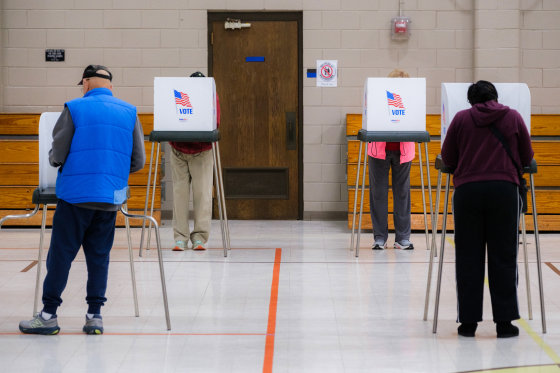
The Republican-led North Carolina House approved a bill Tuesday that would make it easier for residents to challenge other people’s votes and county boards to toss those ballots, alarming critics who say the law could cause post-election chaos.
The bill, which the Senate passed last week, would allow county residents to challenge early voters’ ballots up to three business days after an election. County election boards could then vote to invalidate those votes with a simple majority of members.
Currently, early vote challenges must be filed the day they were cast — before anyone knew how close a race was and how many votes would need to be thrown out to change the outcome — and precinct officials decide the matter on the same day, while only absentee ballot challenges go to the county board. Around 5% of voters cast a ballot by mail in 2024.
County election boards are controlled by Republicans after state legislators stripped the governor of his appointment power and gave it to state Auditor Dave Boliek, a Republican.
The bill now goes to the desk of Democratic Gov. Josh Stein, who sharply criticized the bill in an interview. Stein said Tuesday night that he will veto the law.
In an interview, Stein invoked Jefferson Griffin, a Republican candidate for the state Supreme Court in 2024 who challenged 60,000 votes after he narrowly lost to incumbent Justice Allison Riggs. The legal battle stretched on for six months after the election.
“What I’m worried about is Jefferson Griffin’s lawsuit run wild,” Stein said.
Republicans have argued the bill would strengthen state elections.
In other states, amateur voter fraud hunters have taken to personally perusing voter rolls and challenging votes they believe are ineligible, often based on commercial data that is less reliable than the databases election officials use when they maintain voter roll lists.
In 2022, for instance, fraud hunters challenged at least 92,000 voter registrations in Georgia. Most of the challenges were unsuccessful, but more than 5,700 registrations were removed or moved into pending or challenged status, which requires voters to update their registrations.
The 16-page bill in North Carolina would make several changes to the election process, including slashing primary early voting by a week and requiring a process for the state to remove voters whose registrations are flagged as potentially ineligible in federal databases.
“If somebody’s not eligible to vote, they shouldn’t remain registered to vote,” said state Rep. Phil Rubin, a Democrat. “These things should always have really rigorous due process components to them, and they should have a sort of minimum standard of evidence. We know a lot of those federal databases are incredibly unreliable.”
The bill would also give the state auditor new powers to audit election results.
“The idea of having an auditor audit county boards of elections sounds innocuous, but it allows the auditor to pick and choose which boards he audits, and it has to be seen in light of what the auditor has done to politicize the administration of elections in North Carolina,” Stein said.
NBC News reported in June that Boliek, the auditor, and his office were quietly working to shape counties’ early voting plans, even though critics argue there is no statutory authority for the auditor’s office to influence county election administration.
The bill is the latest push by the Legislature to grant Boliek new election powers.
“They’ve taken this, you know, long-standing statewide office that has frankly been not a particularly prominent or important part of North Carolina politics and turned it into arguably the most important statewide office in North Carolina,” said Chris Cooper, a political science professor at Western Carolina University.
Original source: https://www.nbcnews.com/business
Leave a Reply